Table of contents
A conversation between Michael de la Torre, CEO, and Scott Sherrill, SVP of Regulatory Intelligence
The operating model of compliance in life sciences is changing. For decades, regulatory intelligence has moved slowly with static content, manual reconciliation, and a persistent lag between what regulators publish and what teams actually know. Redica’s new partnership with Veeva Training Solutions was formed to close that gap.
Redica CEO, Michael de la Torre, and SVP of Regulatory Intelligence, Scott Sherrill, sat down to discuss what this partnership means, why it matters now, and what it says about the broader shift happening across life sciences.
Strategic Overview: Why Veeva, Why Now
Michael de la Torre | CEO, Redica Systems
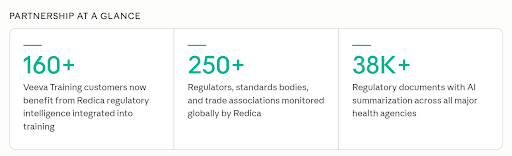
When I think about what Redica’s offering, it’s always been about more than surfacing regulatory data. It’s about making that intelligence actionable within the systems that teams actually live in. Veeva is the system of record for a significant portion of the industry, as its training platform alone serves more than 160 customers. So when Veeva Training Solutions came to us with the idea of using Redica’s intelligence to keep their GxP training content current, I knew it was the coming together of intelligence and workflow.
The gap between what changes in regulations and what gets updated in training content has always been a risk that, in our experience, commonly runs three to six months. This partnership is about eliminating that gap. The fact that Veeva chose to partner with Redica is, in my view, a vote of confidence in both our approach to regulatory intelligence and the quality of our underlying data.
The broader strategy is straightforward: Redica intelligence should flow into wherever decisions get made. For regulatory affairs teams, that’s Veeva RIM. For quality teams, it will be Veeva QualityDocs. For training teams, it’s now Veeva Training Solutions. The winning model isn't another standalone tool; it’s meeting teams wherever compliance decisions get made. Veeva is the first major proof of that model. It won't be the last.
The Intelligence Layer: What It Actually Takes
Scott Sherrill | SVP of Regulatory Intelligence, Redica Systems
The thing people don’t always grasp is how vast the underlying problem is. Redica monitors more than 250 regulators, standards bodies, and trade associations. Some of it is well-structured, but most of it isn’t.
Take the FDA’s updated sterile manufacturing guidance, or the EU GMP Annex 1 revision that affected more than 50 jurisdictions. In both cases, life sciences teams needed to understand not just that something had changed, but specifically which training modules were affected and what the practical implications were for their operations. AI can help process the volume, but you can’t pipe raw health authority output into a model and expect it to tell a GxP training manager what updates they need to make. That’s not how it works.
What Redica has spent years building is the structure that makes AI genuinely useful: a deep taxonomy, universal Redica IDs, our proprietary knowledge graph, and the human curation layer that turns unstructured regulatory output into something teams can act on. AI only works in this domain if the underlying data is already structured. Without that structure, AI tools surface noise instead of answers, and training teams are back to manual triage. Building that structure takes years. It's not a feature you ship; it's infrastructure you earn.
Michael de la Torre | CEO, Redica Systems
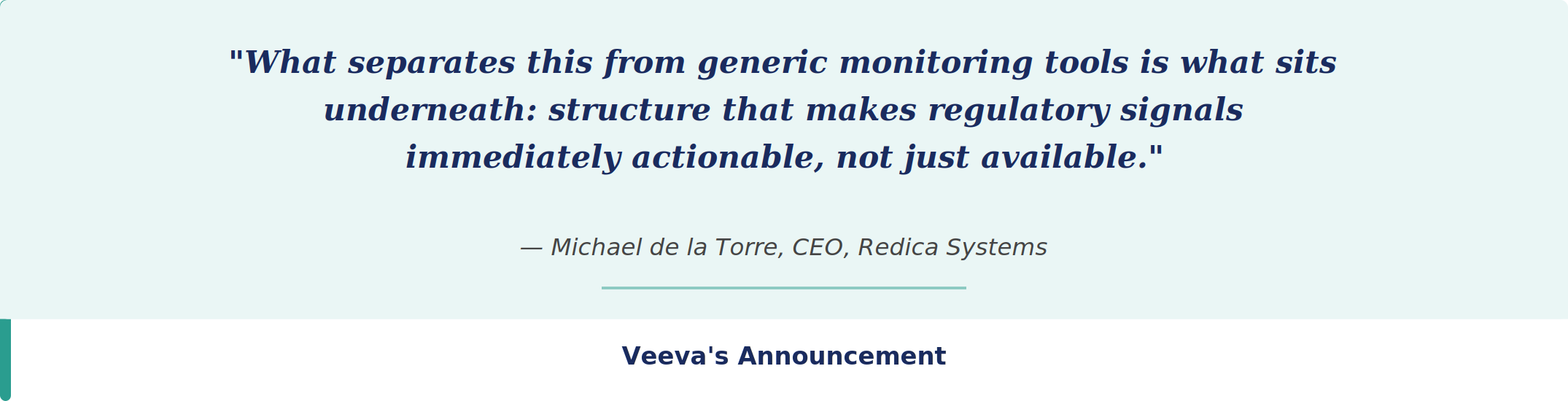
Scott is exactly right, and I want to underscore that point for anyone evaluating this space strategically. There’s enormous enthusiasm right now about using AI to address regulatory and compliance challenges. But the organizations that will get the most value from AI are the ones that have invested in getting the underlying data right first. That’s been Redica’s thesis from the beginning, and it’s why we’re positioned to power partnerships like this one. What separates this from generic monitoring tools is what lies beneath: a structure that makes regulatory signals immediately actionable, not just available.
What This Means for Teams on the Ground
Scott Sherrill | SVP of Regulatory Intelligence, Redica Systems
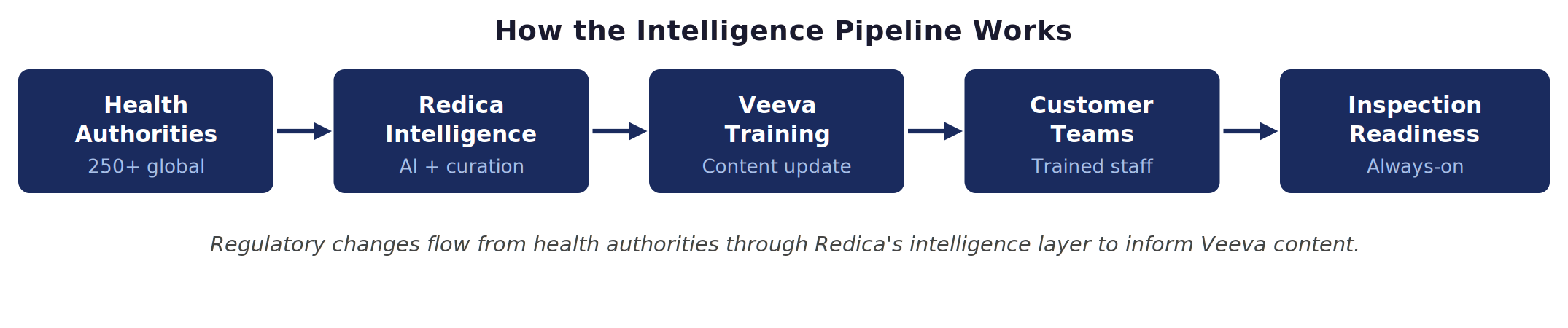
From a practical standpoint, the impact is significant. Training content in life sciences has historically had a major lag problem. When FDA or EMA updates a guidance document, it can take three to six months for that change to work its way into formal training materials, and that’s if it gets there at all. That lag is a real inspection risk. We’ve seen organizations flagged in 483 observations specifically because training content didn’t reflect current regulatory expectations.
That is precisely why Veeva Training Solutions chose Redica as their intelligence partner. Through this partnership, their team can identify and act on relevant changes faster than manual monitoring allows, reinforcing the standard of accuracy and currency their customers already depend on them to maintain. The alternative is a spreadsheet, an SME routing emails, and a lag that compounds every time a new update drops. This partnership significantly reduces that burden.
Michael de la Torre | CEO, Redica Systems
That posture shift has real economic consequences. The cost of manual reconciliation is significant: hours spent by regulatory and quality staff chasing updates, cross-referencing training content, and hoping nothing slipped. Teams that are continuously informed don't just reduce risk; they reclaim that operational capacity. Inspection readiness isn't something you rush to achieve before a site visit — it's a system state you maintain at all times. That's what this makes possible.
Looking Ahead
Michael de la Torre | CEO, Redica Systems
The Veeva Training Solutions partnership is one expression of a larger direction. Redica is building the intelligence layer that life sciences teams need to navigate an increasingly complex regulatory environment. Enforcement activity is accelerating, regulatory fragmentation is getting worse, and the volume of guidance teams must track continues to grow.
Beyond Veeva Training Solutions, Redica intelligence is already available inside Veeva RIM, with Veeva QualityDocs to follow. The goal is straightforward: a regulatory change should surface automatically wherever it matters, whether that's in a training module, a quality document, or a regulatory submission workflow.
Our job is to make sure our customers are always informed, prepared, and ahead of the curve. That means building partnerships with the platforms they rely on, maintaining industry-leading data quality, and continuing to invest in the human expertise — like Scott’s team — that keeps the intelligence layer trustworthy. This partnership is the first visible instance of a broader shift toward embedded regulatory intelligence across the life sciences stack. Regulatory intelligence embedded where work happens is the future, and it starts here.
Learn more about how Redica intelligence works where your team already operates.
.png)
Michael de la Torre is the CEO of Redica Systems, a data and analytics platform, which helps life sciences companies reduce compliance risk throughout their supply chain. A data analyst at heart, Michael seeks to combine the best of industry expertise with technology to produce extraordinary insights and actionable intelligence to create new ways of decision-making, powered by highly domain-specific and complex data. Michael previously served as the CRO for LeisureLink, a VP/GM at Sungard Availability.

Scott leads Regulatory Intelligence and Regulatory Affairs at Redica, shaping product innovation and market strategy to help organizations anticipate regulatory change and enforcement risk. His cross-functional leadership bridges data, product, and customer needs across the regulatory lifecycle.
