
Table of contents
FDA's new one-day inspectional assessment pilot is the agency's latest attempt to expand surveillance coverage without expanding inspection budgets. Its closest precedent is the Remote Regulatory Assessment program, and the volume data tells a useful story.
On May 6, FDA announced it has been piloting one-day inspectional assessments since April. The pilot extends FDA's surveillance footprint without committing the resources of a full inspection. As of late April, the agency had completed roughly 46 of these shorter assessments, and most ended in No Action Indicated.
The reaction from quality and regulatory teams has been immediate, and a version of the same question is showing up in conversations across the industry: how should we think about FDA one-day inspections, and what should we expect them to produce?
The most useful way to answer that question is not to speculate about observation profiles when only a few dozen of these assessments have closed. It is to look at the closest precedent FDA already has for expanding oversight without expanding inspections: the Remote Regulatory Assessment program. The trajectory of RRA usage from 2020 through 2025 frames the one-day inspection pilot in a way the press release does not.
What FDA actually announced about one-day inspections
The pilot runs across multiple FDA inspectorates: human and animal foods, biologics, medical products, and clinical research. Facilities are picked using risk-based criteria, with FDA citing product type, prior inspection outcomes, and operational characteristics as inputs. FDA Commissioner Marty Makary framed the rationale this way:
“One-day inspections can strengthen our inspectional approach by focusing our time and resources where they are most needed, enhancing our overall effectiveness.” — Marty Makary, M.D., M.P.H., FDA Commissioner
A few details from the announcement deserve attention:
- These assessments do not replace standard inspections. FDA was explicit on this point. They sit alongside the existing inspectional toolkit.
- Investigators retain authority to expand scope or duration. Some pilot assessments have already extended beyond a single day when significant observations surfaced.
- Higher-risk facilities are out of scope. The pilot is targeted at lower-risk establishments where FDA wants broader coverage without consuming a full inspection.
- The data feeds back into FDA's risk models. The agency will use what it learns from these assessments to refine how it targets future oversight.
That last point is the strategic one. FDA Associate Commissioner for Inspections and Investigations Elizabeth Miller signaled the intent directly:
“We are closely analyzing the operational and compliance data from these assessments, including trends in outcomes, risk signals, and investigator feedback, to determine how this approach can enhance our broader inspectional strategy.” — Elizabeth Miller, Pharm.D., FDA Associate Commissioner for Inspections and Investigations
Translation for industry: every one-day assessment is an input to a risk model that will help decide who gets inspected next, and how. Recurring compliance themes, facility-specific risk scores, and discrepancies between registered and actual operations will all feed that model.
The closest precedent: what RRA data already tells us
If the goal is broader surveillance coverage without expanding the inspectional footprint, FDA has tried this before. Remote Regulatory Assessments emerged during the COVID-19 public health emergency, when travel restrictions made on-site inspections difficult. The agency used record requests, virtual interviews, and livestream walkthroughs to assess compliance without sending an investigator on-site. In June 2025, FDA finalized its guidance on RRAs, formalizing them as a permanent tool across all FDA-regulated product categories.
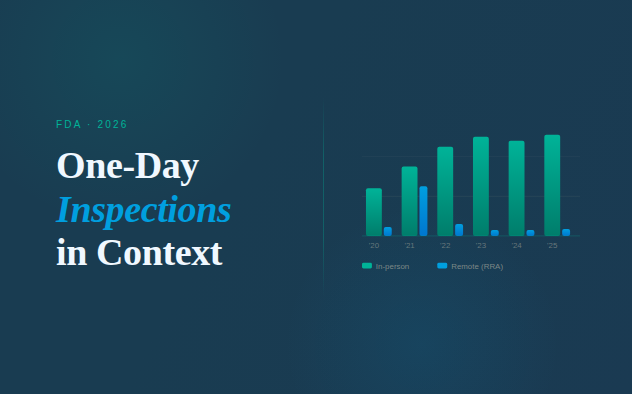
The volume data from Redica's platform tells the rest of the story. RRAs scaled rapidly during the pandemic, then receded just as quickly:

Three things stand out. First, RRAs peaked sharply in 2021 at over 1,500 assessments and have settled at roughly 200 per year since 2023, well below their pandemic-era usage even though the formal guidance now permits broader application. Second, in-person inspections have continued growing through the same period, reaching nearly 31,000 in 2025. Third, RRAs never came close to substituting for inspections at scale: even at peak, they accounted for less than 6 percent of FDA's total assessment activity.
That last point matters for understanding the one-day inspection pilot. The strategic problem RRAs were designed to solve, expanding oversight reach efficiently, has not gone away. But the data suggests RRAs as currently structured have not become FDA's primary tool for that purpose. One-day inspections look like the agency's next attempt at the same problem, this time keeping the investigator on-site but compressing the visit.
Why this matters for quality and regulatory teams
The RRA trajectory suggests a few things about how the one-day inspection pilot may evolve.
If FDA finds that one-day assessments produce useful risk signals at scale, the pilot is likely to expand more aggressively than RRAs did. The structural advantages are real: an investigator on-site can see equipment, observe operations, and exercise inspectional authority that an RRA cannot. If the assessments are well-suited to the lower-risk establishment population they are targeting, the volume could grow substantially within fiscal year 2026.
If, on the other hand, the pilot runs into the same constraints that limited RRA scale, namely that complex facilities require time on-site that cannot be compressed without losing inspectional value, the program may settle into a niche role. The fact that some pilot assessments have already extended beyond a single day is an early signal that the duration limit is less rigid than the name suggests.
Either way, the practical implication for industry is the same: FDA is actively experimenting with how it allocates inspectional resources, and the outputs of those experiments feed directly into how the agency targets oversight. Facilities that have not been inspected in several years should not assume they remain off the radar. The same risk models that select sites for RRAs and one-day assessments are running continuously in the background.
FAQ: FDA one-day inspections
Are FDA one-day inspections replacing full inspections?
No. FDA stated clearly that one-day inspectional assessments complement standard inspections rather than replace them. Full, multi-day inspections will continue, particularly for higher-risk and more complex facilities.
How do one-day inspections relate to Remote Regulatory Assessments?
Both are tools for expanding FDA's surveillance reach beyond the cadence of full inspections. RRAs are remote and do not result in a Form 483. One-day inspections are on-site and follow standard inspectional procedures, including the possibility of issuing a Form 483 at closeout. RRAs were used heavily during the COVID-19 pandemic and have receded since. One-day inspections appear to be FDA's next iteration of the broader-coverage strategy, this time with investigators on-site.
Which facilities are eligible for one-day inspections?
FDA is selecting facilities using risk-based criteria including product type, prior inspection outcomes, and operational characteristics. The pilot is focused on lower-risk establishments. Higher-risk and more complex sites continue to receive standard inspectional coverage.
Can a one-day inspection turn into a multi-day inspection?
Yes. FDA confirmed that some pilot assessments have already extended beyond one day when investigators identified significant observations. Investigators retain full authority to expand the scope or duration of an assessment when warranted.
How long will the FDA one-day inspection pilot last?
FDA has stated that the pilot will continue through fiscal year 2026, with additional assessments planned across inspectorates. The agency is developing evaluation metrics including inspection duration, escalation rates, and the utility of findings to inform risk-based decision-making.
Watching the pilot as it expands
The most useful thing quality and regulatory teams can do right now is track the pilot's volume and outcomes as the cohort grows. How quickly does FDA scale the program? Do escalation rates from one-day to multi-day stay low, or do they climb? How does the geographic and sector distribution evolve? Each of these signals will say something about where one-day inspections sit in FDA's longer-term oversight strategy, and whether the trajectory looks more like the RRA arc or like something new.
Redica's platform tracks FDA inspection activity across modalities and surfaces the patterns that distinguish one period from the next. If you want to see how your sites compare to current inspection trends, or want a closer look at the RRA volume data behind this analysis, Redica's Inspection Intelligence platform is built for exactly that kind of question.
Sources: FDA Launches One-Day Inspectional Assessments to Strengthen and Expand Oversight, FDA press release, May 6, 2026. Conducting Remote Regulatory Assessments—Questions and Answers, FDA Final Guidance for Industry, June 26, 2025.
